Magnesium Dosing in the Planted Aquarium
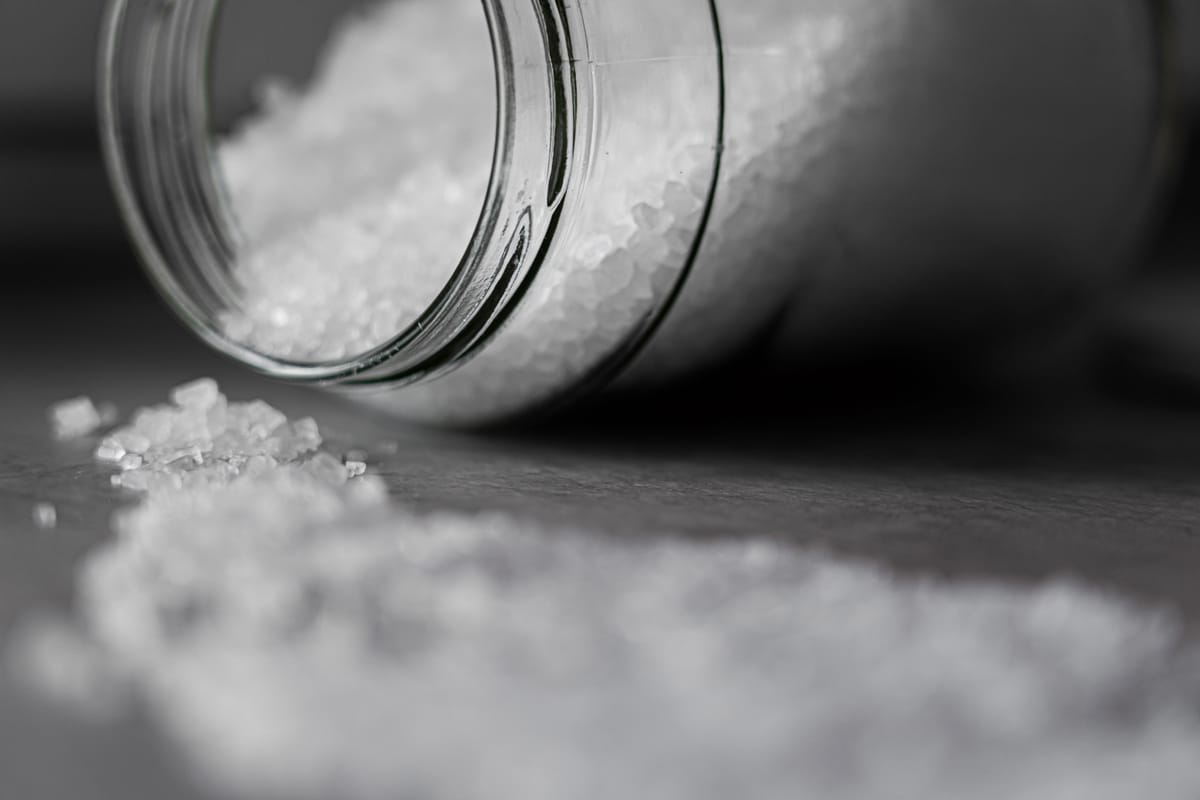
Magnesium is part of chlorophyll and therefore directly involved in photosynthesis. In tap water it usually sits in a ratio to calcium (Ca:Mg) — a common rule of thumb is around 3–4:1 by mass; when the ratio runs notably higher, targeted magnesium dosing is a sensible addition.
Is Epsom salt the same thing as magnesium sulfate?
Yes. Epsom salt is simply the common name for magnesium sulfate heptahydrate (MgSO₄·7H₂O) — the same compound whether it's sold at a pharmacy, drugstore, or as a garden fertilizer.
Why does the label show only ~16% magnesium oxide — where's the rest?
Because a large part of the mass is crystal water, locked firmly into the salt during crystallization — not an impurity, but part of the chemical formula. The heptahydrate (7 water molecules per formula unit) has a molar mass of 246.47 g/mol, of which 9.86% is magnesium, or 16.35% magnesium oxide (MgO, the usual declaration form on fertilizer labels). The remainder is sulfate and the crystal water.
How much Epsom salt do I need?
For +5 mg/l magnesium in 100 liters of water change (0.5 g magnesium total), at 9.86% Mg content that's about 5 g of Epsom salt.
Technical-grade Epsom salt from the hardware store, or pharmacy grade?
Both are chemically the same compound; what matters is whether it dissolves completely and without residue. Technical-grade material from a hardware/garden store comes without an analysis certificate but is fine for typical aquarium doses — as long as it dissolves clearly and contains no additives (anti-caking agents, dyes). If you want certainty, go with declared pharmacy or lab grade.
A trap when substituting garden fertilizer: kieserite
Kieserite is also magnesium sulfate, but as the monohydrate (only 1 water molecule instead of 7) — which gives it 17.56% magnesium, almost double that of Epsom salt (factor 1.78). If you switch to kieserite garden fertilizer for cost reasons and weigh it out using an Epsom-salt recipe, you'll overdose accordingly. For aquarium dosing, magnesium sulfate heptahydrate explicitly labeled as Epsom salt is the simpler choice.
Frequently Asked Questions
Is Epsom salt the same thing as magnesium sulfate?
Yes. Epsom salt is simply the common name for magnesium sulfate heptahydrate (MgSO4·7H2O) — the same compound whether it's sold at a pharmacy, drugstore, or as a garden fertilizer.
Why does the label show only a fraction of magnesium?
Because a large part of the mass is crystal water, locked firmly into the salt during crystallization — not an impurity, but part of the chemical formula. Heptahydrate contains 9.86% magnesium, or 16.35% magnesium oxide (MgO); the remainder is sulfate and the crystal water.
How much Epsom salt do I need for a given magnesium increase?
For +5 mg/l magnesium in 100 liters of water change (0.5 g magnesium total), at 9.86% Mg content that's about 5 g of Epsom salt.
Can I use kieserite from the garden center instead of Epsom salt?
Not without adjusting the amount. Kieserite is also magnesium sulfate, but as the monohydrate, with 17.56% magnesium — almost double that of Epsom salt (factor 1.78). Weighing it out using an Epsom-salt recipe will overdose accordingly.
Technical-grade Epsom salt from the hardware store, or pharmacy grade — what matters?
Both are chemically the same compound. What matters is whether it dissolves completely and without residue, and contains no additives such as anti-caking agents or dye — not where it came from.
Use the calculator to work out the right magnesium dose for your own tank.