Mixing Your Own Aquarium Fertilizer
Why bother mixing your own
The macronutrients a plant needs most — nitrogen (N), phosphorus (P), potassium (K) — are chemically about as simple as it gets: one or two salts dissolved in water. Commercial liquid fertilizers sell exactly that, at a significant markup. The savings are roughly a factor of 10 to 20, depending on the brand. That's why DIY dosing of macros has been standard practice in the hobby for years (known under names like "EI" or "PPS-Pro") — while DIY iron and micronutrients are much less common, because that chemistry is harder to get right. Sodachi follows the same split: mix your own macros, buy ready-made iron/micro.
The core idea: a stock solution instead of guessing
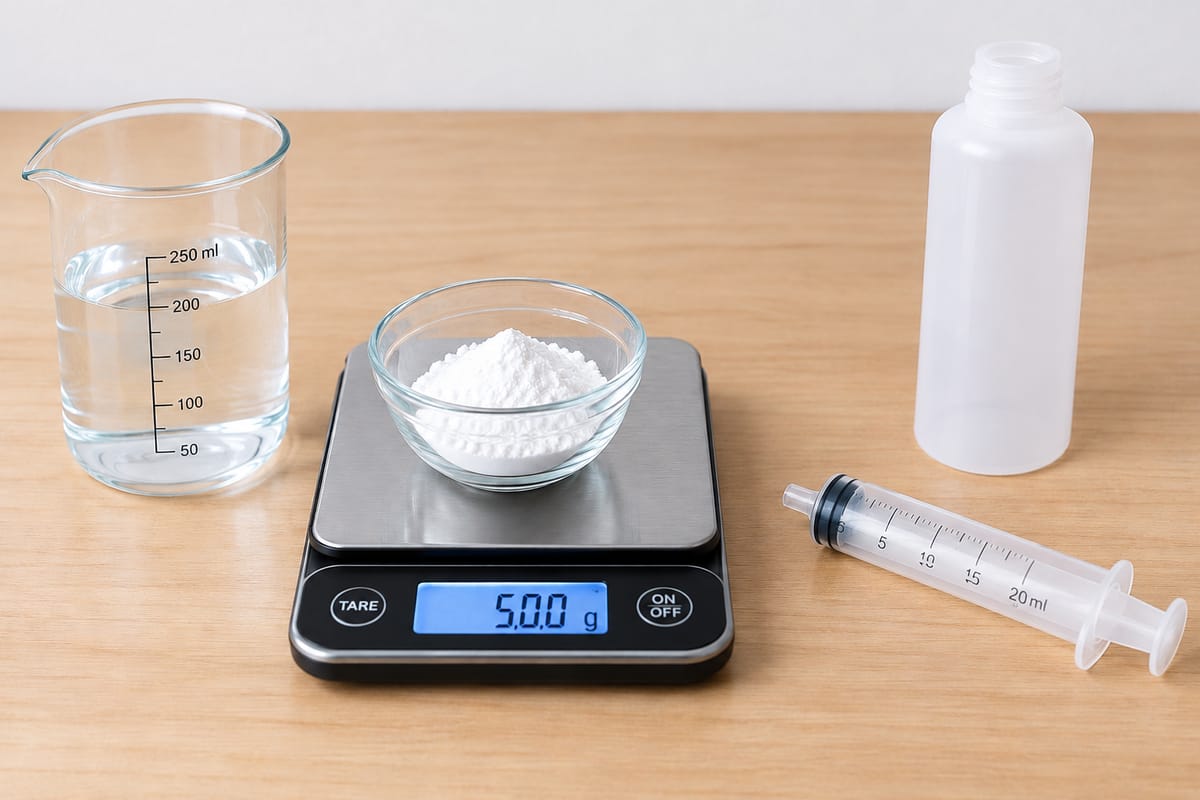
You don't want to guess how much powder "a pinch" is — you want to add a specific amount of a nutrient that matches your Sodachi target value. You do that by dissolving a precisely weighed amount of salt in a precisely measured amount of water (a stock solution), then dosing a set amount of that solution daily with a syringe.
An example using potassium nitrate (KNO₃, which supplies nitrogen as nitrate and potassium as a built-in side effect):
- Dissolving 50 g of KNO₃ in 500 ml of water gives a stock solution with about 61 mg of nitrate per ml.
- Dosing 10 ml of that daily into a 100-liter (≈26-gallon) tank raises the nitrate concentration by about 6 mg/l per day.
Potassium comes along automatically: in the same example, the potassium concentration rises by about 3.9 mg/l per day at the same time — KNO₃ delivers both ions in a fixed ratio that can't be separated. If you dose KNO₃ exclusively to hit a nitrate target over the long run, potassium builds up whenever your actual potassium need is lower than what comes along for free. That's why dedicated potassium salts without nitrate exist (see the table below) — to adjust potassium independently.
That's the whole logic — only the numbers change for other salts and other tank sizes. Sodachi works out the exact numbers for your tank and your target value directly; this article just explains the principle behind them.
Three things that actually matter — brand and shop don't
Where you buy doesn't matter for the chemistry, whether it's a garden-supply store, a chemical supplier, or a hydroponics shop. These three things do:
1. Substance identity. Common names are ambiguous — "saltpeter" alone could mean potassium, calcium, or sodium nitrate, and only the first one gives you what you want. Buy by chemical name or formula, not by the everyday label. (A common mix-up — monopotassium phosphate vs. dipotassium phosphate — and the hydration-state trap with Epsom salt each get their own article, because they trip people up more than expected.)
2. Grade/purity. Look for "fully water-soluble" or greenhouse grade — conveniently, this is also the cheapest legitimate source, usually sold for hydroponics. Be cautious with loose bulk goods: often not fully soluble, mixed with anti-caking agents, and phosphates can carry trace cadmium. The simplest practical test: if it dissolves clearly with no residue, it's fine.
3. No additives. Bulk agricultural urea is frequently coated with a urease inhibitor that blunts its effect in an aquarium — not suitable for DIY fertilizer. (Urea as a nitrogen source gets its own article too.)
Where the source does matter: in the EU, potassium nitrate is classified as a reportable (not restricted) explosives precursor (Annex II of Regulation (EU) 2019/1148) — no purchase limit or licence for consumers, just a duty for sellers to report suspicious orders. Some general chemical suppliers still decline to sell to private individuals anyway, as their own risk policy rather than a legal requirement; hydroponics and aquascaping specialty shops sell it to hobbyists far more reliably. Rules outside the EU vary — check what applies where you live.
The main salts at a glance
| Ion you want to dose | Common salt | Chemical name |
|---|---|---|
| Nitrogen (as nitrate) + some potassium | KNO₃ | Potassium nitrate |
| Phosphorus (as phosphate) + some potassium | KH₂PO₄ | Monopotassium phosphate (MKP) |
| Extra potassium, without nitrate/phosphate | K₂SO₄ or KCl | Potassium sulfate / potassium chloride |
| Magnesium | MgSO₄ · 7H₂O | Epsom salt |
All four dissolve clearly in water, are easy to find in hydroponics-grade purity, and none of them carries a purchase or quantity restriction.
Practical notes
- Scale: At these quantities you need a precision scale accurate to 0.1 g — a standard kitchen scale isn't precise enough.
- Dissolving: Always add the salt to the water, not the other way round, and stir until nothing settles.
- Storage: Keep it cool, dark, and sealed — and label the container (salt, date, concentration). After a few months, mix a fresh batch rather than keep using an uncertain solution.
- Handling: Not food. Keep away from kids and pets, wash your hands after weighing.
Frequently Asked Questions
Is homemade fertilizer as good as store-bought?
Yes. Commercial liquid fertilizers are made from the same salts, just dissolved and sold at a markup. What matters is getting the right substance and a clean grade.
Can I legally buy potassium nitrate as a private individual?
In the EU, potassium nitrate is classified as a "reportable" — not restricted — explosives precursor (Annex II of Regulation (EU) 2019/1148): no purchase limit or licence for consumers, just a duty for sellers to report suspicious orders. Some general chemical suppliers still decline to sell to individuals as their own risk policy; hydroponics and aquascaping specialty shops are the more reliable source. Rules outside the EU vary, so check what applies where you live.
Is it safe to mix your own aquarium fertilizer?
Yes, with the common macro salts (potassium nitrate, monopotassium phosphate, potassium sulfate, Epsom salt), as long as you get the substance and grade right. As with any household chemical, don't ingest it, keep it away from kids and pets, and label your containers.
How long does a mixed fertilizer solution keep?
Stored cool and dark, usually several weeks to a few months. If it turns cloudy or smells off, mix a fresh batch instead of dosing it.
Why not mix iron and micronutrients myself too?
Iron needs to be bound to a chelator to stay plant-available instead of precipitating out immediately. That chelate chemistry is risky to get right at hobby scale, and ready-made micro mixes are cheap enough that it isn't worth the risk.
What's next
With the salts and the stock-solution logic covered, Sodachi works out exactly how much of which salt your tank needs to hit your target value.